Back to Data and Methods
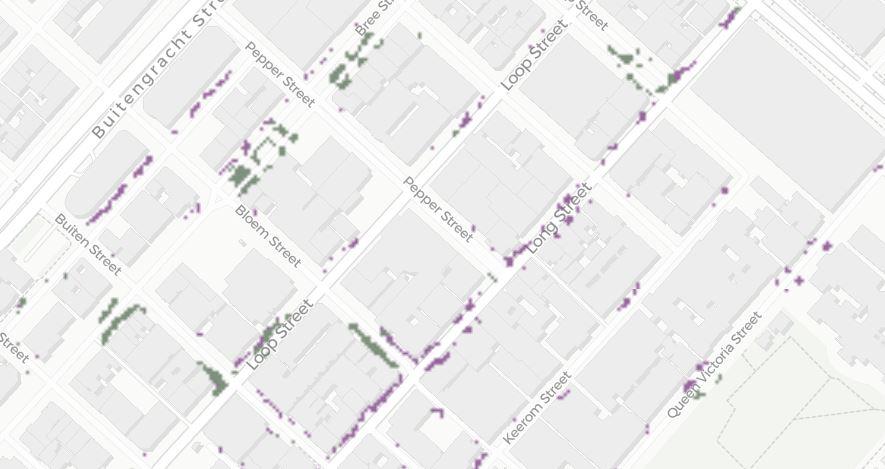
Shade (Baseline)
Overview
This layer shows areas shaded by buildings and trees at 3 p.m.. Shade is modeled using the open-source SOLWEIG (SOlar and LongWave Environmental Irradiance Geometry) model, which simulates shadows based on the three-dimensional structure of buildings and trees, ground elevation, and the position of the sun. The model estimates how shade moves and changes throughout the day across the study area.
Caution: the 1m resolution shade dataset is calculated based on sun angle and open-source building and tree data, which can contain errors in feature placement and height. Therefore, the 1m shade pixels are likely to have inaccuracies, but mostly at only very micro-scales of a few meters.
Function
To identify where shade reduces heat exposure and to support analysis of how shading influences local thermal conditions.
Source
OpenUrban, OpenStreetMap, Overture Maps, UT-GLOBUS, WRI/Meta global tree canopy
Data sources
OpenUrban, OpenStreetMap, Overture Maps, UT-GLOBUS, WRI/Meta global tree canopy
Spatial resolution
1 meter
Spatial coverage
Areas of interest identified by cities
Temporal resolution
Hour
Temporal coverage
Data corresponds to one historical day of reference based on highest registered air temperature during the previous five years.
Cautions
Modeled shade data is only as strong as its supporting layers. Our input datasets may not be completely accurate in terms of the location and height of urban features like buildings and trees. The shade data is suitable for guiding assessments of heat and the potential for creating interventions, but it will not show every tree or building shadow accurately. The 1m resolution shade dataset is calculated based on sun angle and open-source building and tree data, which can contain errors in feature placement and height. Therefore, the 1m shade pixels are likely to have inaccuracies, but mostly at only very micro-scales of a few meters.